Image
War is easily visualized yet nearly impossible to summarize, particularly when active hostilities are suspended under an armistice rather than being resolved through formal treaty agreements. Nevertheless, each individual touched by war and its aftermath has a personal story that is ultimately woven into the fabric of history. What, then, does reimagining war look like?
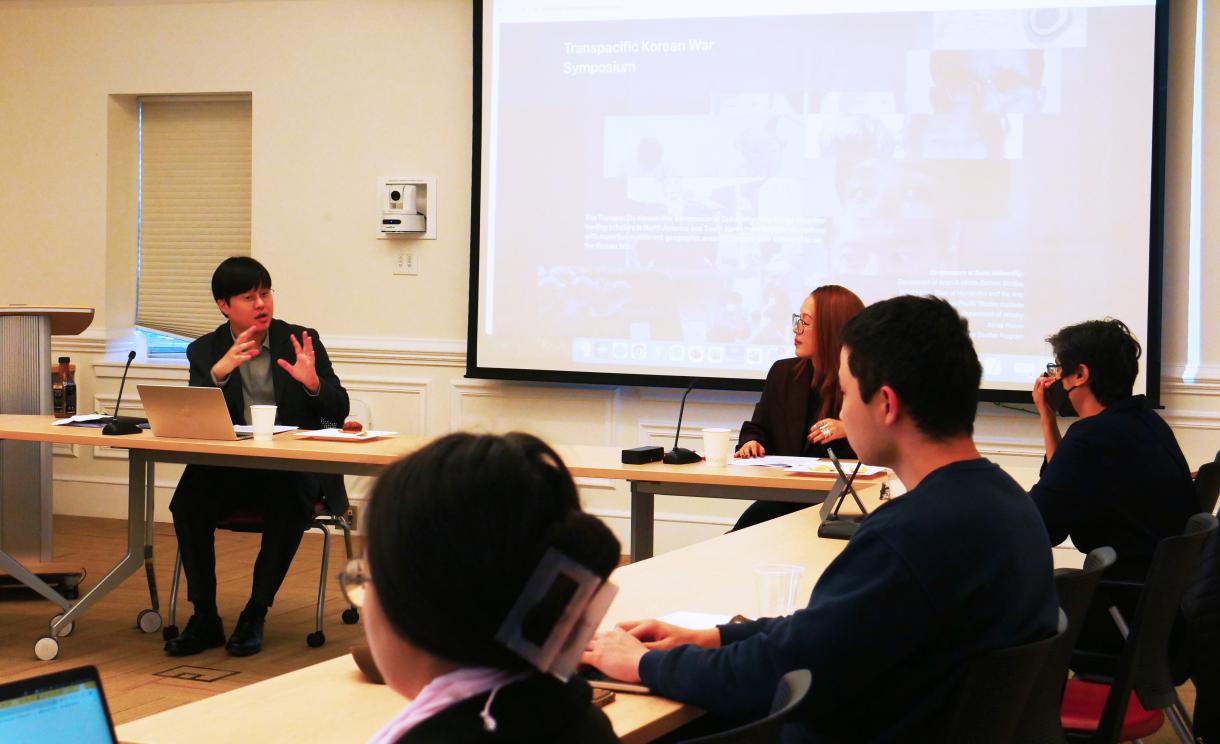
In late October 2025, six intrepid scholars convened at Duke University to re-examine the Korean War in a global context, transcending the typical U.S.–Korean nexus. Reconceptualizing the struggle as a broader Transpacific Korean War enables us to speak to the geopolitical and biopolitical technologies of “forever wars” that convert entire peoples and ecologies into collateral damage.
Through combining diverse methodologies such as diaspora studies, indigenous studies, critical ethnic studies, gender and sexuality studies, queer studies, environmental humanities, and disability studies, the scholars who shared their work during this symposium are contributing to a larger project, unmooring disciplinary boundaries to expand the reach and scope of Korean Studies. Their efforts will make the specific subject of the Korean War more accessible to researchers in multiple academic disciplines.
Drawing on the fields of cultural studies, history, international studies, regional studies, language, gender and sexuality studies, literature, and public policy, this project begins on the Korean peninsula before reaching beyond to include histories and peoples of the Pacific Islands, the Caribbean, Latin America, and Southeast Asia, who are frequently left out of the dominant accounts of the Korean War despite their involvement in both the active and frozen periods of the conflict.

By exploring new pathways for trans-disciplinary research in the humanities, the scholars at this symposium created a space for innovative work on the Korean War. During each session, the presenters rigorously interrogated one another before opening to feedback and questions from an engaged audience.
The symposium environment offered constructively critical perspectives, advancing individual research as well as the overarching project which will form the basis of a forthcoming special issue of Korea Journal, a peer reviewed, international and interdisciplinary research journal that focuses on all aspects of Korean studies. Due to support from the Academy of Korean Studies, the edition will be available via open access, so scholars around the world will be able to freely access the publication online.
Visit the symposium website to learn more about each of the presenting scholars and to read the abstracts of their presentations.

Queering ‘Freedom’s Frontier’: Homosocial Soldiering and Racialized Masculinity across Korea and Vietnam
“By reframing KATUSA masculinity through a decolonial lens, I argue that it must be situated within trans-imperial entanglement that links the U.S., Japanese, and French imperial legacies that shaped both the Korean and Vietnam wars and the Korean soldiers.”
Racialized Intoxication: Ongoing Korean War Fantasies of Non-Disabled Futurity in Okinawa and South Korea
“The distinction between medicine and narcotic, between therapeutic agent and dangerous substance, derives not from actual molecular structure, but from who uses the substance under what conditions and whose power defines its legal status. … Pharmaceutical meaning is not discovered through pharmacology, but assigned through power.”
“Blood Alliance” for (Market) Freedom: The Korean War’s Afterlife in the Transpacific Economic Fantasy and Post-conflict Nation-building in South Korea–Colombia Relations
“There's war, the Korean War, and then the country rose up from the ashes with the help of U.S. aid, and we now share with those who request our knowledge. It's almost secretly presupposed in every account by the Korean government’s self-storytelling of the economic miracle, because it signifies as the alignment with the free world that made South Korea distinguishable and go from aid recipient to donor.”
Shadows on the Tracks: Seeing Partition and War from Korea to Pakistan
“There's a train station in the DMZ, which is pointing the way to reunify in future. In that particular state-sponsored project, the train represents this sort of ending of the partition. Of course, if you go there as a tourist, it's very weird. This really modern train station is empty, and you can see the train tracks going on, but you know that's North Korea. It's unfinished, and then going backwards, like to the Korean War. One of the iconic [wartime] images was refugees on top of the train, fleeing. It becomes a trope of refugees escaping the conflict. We have those exact same images in South Asia.”
Minor Identifications: The Affective Politics of Empire in Cathy Park Hong’s Dance, Dance, Revolution
“Han is a Korean national affect. It's much pathologized, but it's this unspeakable sense of sorrow that cannot be communicated and translated. … The argument of this historiography is that the idea of Korean han actually is a modern invention, and that it resonates with stereotypes of Koreans that the Japanese colonial administration coined for Japanese esthetes, who liked Koreans because they were so sad and produced this beautiful, sad art. Some of the historic biography argues that that actually becomes the basis of a kind of nationalist assertion of han. It's a taking up of Korean identity that comes from the colonizer but gets repurposed by the colonized as a kind of nationalist rallying point.”
Transpacific Freedom Dreams Across Korea-Mexico: The Specter of North Korea and Insurgent Kinships in José Revueltas’s The Motives of Cain
“The specter of North Korea incessantly reminds us of South Korea's position in the U.S. empire, bases which yoke together disparate geographies and peoples. The Cold War violently conscripted global south countries into dirty wars against communism, from the genocide of entire populations to the incarceration of torture and disappearance of dissidents. While the U.S. was executing total war in Asia and in Latin America, the United States equipped proxy militaries and governments to obliterate even hints of communism.”