Image

This isn’t an ad, but I truly enjoyed my time at Middlebury College’s Japanese School and would recommend it to anyone who aspires to improve their foreign language skills — and who has the necessary funds.
Middlebury’s most distinctive feature is its Language Pledge: you agree not to speak English (or any other language) except the one you are learning. It sounds intimidating at first, but in practice it’s not as difficult as people imagine.
As an international student in the U.S., I already live under an “English-only” pledge every day, so switching into Japanese full-time didn’t feel daunting. My classmates felt the same way: most of us quickly grew comfortable, and by the end of the program, some even found it hard to switch back from our “Japanese persona” to other languages.
For students like me — who use English as a second language and study Japanese as a third — the pledge had another benefit. It leveled the playing field. Everyone, regardless of whether they were native English speakers or not, had to use Japanese. For the first time, I felt completely integrated with my American classmates. In just two months, I talked with them more than I had in the previous two years in the U.S.
I was placed in Level 3: Intermediate Japanese I, and had four wonderful teachers, each with their own style:
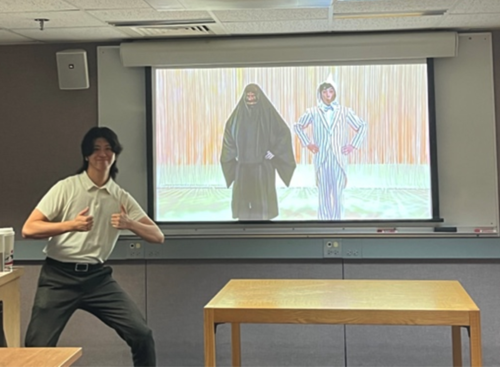
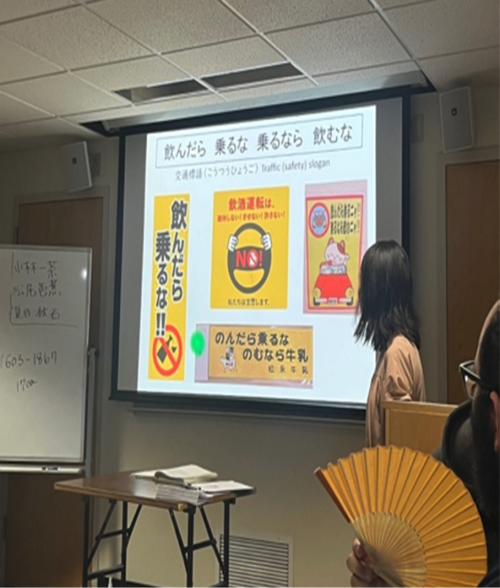
Classes ran from 8:00 a.m. to noon with four sessions back-to-back.
The first covered the textbook, while the others focused on grammar, discussion, writing, and activities in small groups.
With only ten-minute breaks (and occasional overtime), I was exhausted by the end of each day.
Still, the intensity made the program very effective.

Every evening, students also gathered in the lounge to play Uno or other games—a fun, informal way to practice Japanese and bond with friends.
The student body was incredibly diverse: high schoolers, working professionals, college students from across the U.S., and peers from China, Hong Kong, Tibet, India, and Korea.
Meals were especially social. Teachers and students from all levels shared round tables, making it easy to meet new people. Honestly, I made more American friends at Middlebury in two months than in two years of studying in the U.S.!
Of course, not all interactions were ideal—a few people tried to “hit on” me. But even those encounters became part of the language practice (after all, it had to be done in Japanese!).
Middlebury offered a wide range of cultural activities: origami (折り紙), calligraphy (書道), shogi (将棋), karaoke, reading groups, and karuta.
Weekends featured Japanese films such as The Secret World of Arrietty(借りぐらしのアリエッティ), Weathering With You(天気の子), and Tale of an Osaka Love Thief(大阪恋泥棒).
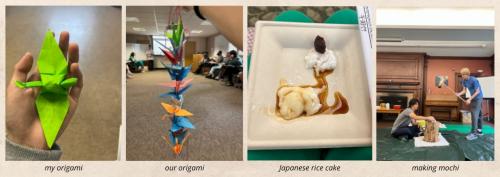
Special events included making somen noodles (素麺), pounding rice cakes (餅), a summer festival (夏祭り), and a karaoke party. In one class, we folded origami cranes to pray for world peace.
These activities enriched my understanding of Japanese culture in ways I never expected.

All students and teachers lived together in Hepburn Hall.
The building was full of Japanese labels, immersing us even more in the language:
— 給水所 (water fountain)
トイレ (toilet)
自動販売機 (vending machine)
One quirky detail: bats (コウモリ) often flew into the building! It was my first time seeing a live bat up close.
Before Middlebury, I had completed Japanese 101 and 102 at Duke. Knowing Chinese characters gave me an advantage, so I was placed into Intermediate I. I also self-studied the remaining chapters of Genki II before arriving.
By the end of the program, I scored 6.75/9 on the STAMP 4 test, placing me at an intermediate-advanced level.
Professor Sogabe told us that we were roughly at JLPT N3, and with stronger kanji skills, we could prepare for the N2 exam.
Middlebury’s Japanese School gave me not only language skills but also friendships, cultural insights, and a sense of belonging. It was an intense, transformative summer, and I would highly recommend it to anyone serious about improving their language abilities.